Cannabis Education
Gummies for Sleep
Oct
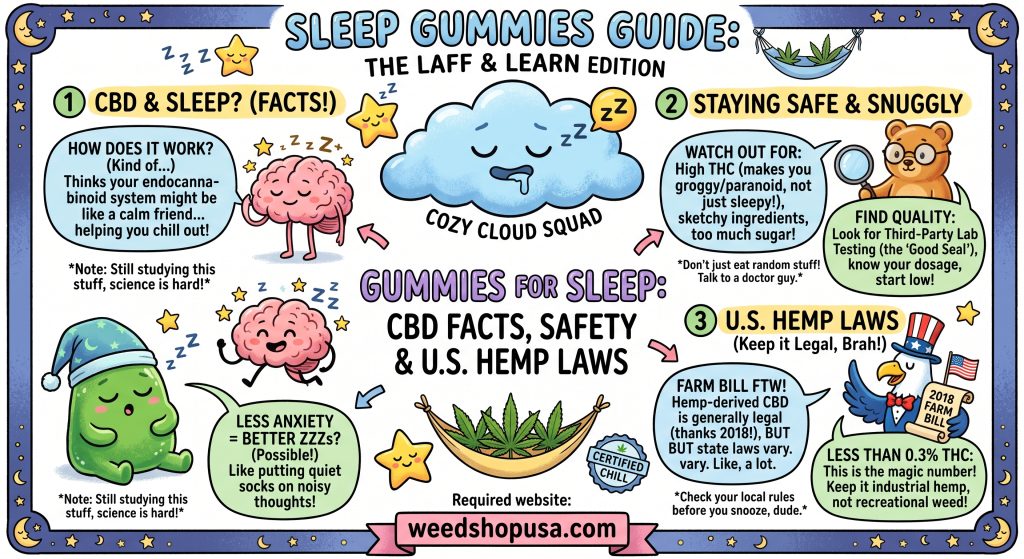
Gummies for Sleep: CBD Facts, Safety, and U.S. Hemp Laws
Gummies for sleep attract attention because they seem like a convenient answer to restless nights. However, products with similar packaging can contain very different ingredients, including melatonin, cannabidiol (CBD), tetrahydrocannabinol (THC), or combinations of these substances. Understanding those differences matters more than choosing an appealing flavor or trusting a nighttime label.
For U.S. readers, two questions deserve attention: what does the evidence say, and what rules apply to the specific product? A gummy’s availability online does not establish its effectiveness, safety, or legality where you live.
This guide explains broad spectrum CBD sleep gummies, the meaning of “insomnia gummies,” and why hashish differs from CBD. It also addresses hemp laws by state and the common question, “Is hemp legal in all 50 states?”
What Are Gummies for Sleep?
“Gummies for sleep” describes a marketing category rather than a standardized medical treatment. The phrase alone tells you little about a product’s contents or whether researchers have studied its exact formula.
Start by identifying the active ingredients:
| Product type | What the label generally indicates | What to check |
|---|---|---|
| Melatonin gummies | Contains a hormone involved in sleep timing | Amount per gummy, additional ingredients, and suitability |
| CBD isolate gummies | Uses an extract intended to contain CBD alone | Batch testing and measured cannabinoid content |
| Broad spectrum CBD gummies | Contains CBD and other plant compounds, with THC generally removed | THC detection limits and the current laboratory report |
| Full spectrum CBD gummies | Contains multiple cannabinoids, potentially including THC | Actual THC amount and applicable restrictions |
| THC-containing gummies | Contains an intoxicating cannabinoid | Impairment risks, ingredient amounts, and local legality |
These categories can overlap. For example, a broad spectrum product may also contain melatonin. Read the complete ingredient list rather than assuming that CBD is responsible for every effect described in customer reviews.
For further educational exploration, visit weedshopusa.com and use the questions in this guide when assessing cannabis-related information.
Do Gummies for Sleep Actually Work?
The answer depends on the ingredient, the individual, and the underlying sleep problem. Difficulty falling asleep after a schedule change differs from persistent insomnia, sleep apnea, or sleep disruption related to medication.
Research into cannabinoids and sleep remains limited. The National Center for Complementary and Integrative Health describes insufficient evidence to support cannabinoid therapies for sleep disorders in the review it summarizes. That means commercial CBD gummies should not be presented as established insomnia treatments. Read its overview of sleep disorders and complementary health approaches. NCCIH
A positive review can describe someone’s experience, but it cannot show which ingredient caused an improvement. Changes in bedtime habits, expectations, and other treatments can influence perceived results.
When evaluating a claim, ask:
- Was the exact product studied in people?
- Did the study include a comparison group?
- Did researchers measure sleep rather than general relaxation?
- Was the improvement meaningful?
- Were side effects and longer-term outcomes assessed?
Statements such as “guaranteed deep sleep” or “cures insomnia” go beyond what a pleasant customer experience can establish.
Broad Spectrum CBD Sleep Gummies: What Does the Label Mean?
Broad spectrum CBD sleep gummies generally use an extract containing CBD and additional cannabis compounds, with THC removed during processing. However, “broad spectrum” does not independently verify the contents of the finished gummy.
A useful laboratory report, often called a certificate of analysis or COA, should match the product’s batch number. A report for a different batch or an ingredient used before manufacturing provides less direct information about the package in front of you.
Questions to Ask About a CBD Laboratory Report
Check whether the report identifies:
- The finished product and matching batch.
- The laboratory and testing date.
- CBD content and the units used.
- THC results and the method’s detection limits.
- Relevant contaminant testing.
“Not detected” means the test did not detect a substance above its reporting threshold. It does not prove that absolutely none exists.
Likewise, “THC-free” is a claim to evaluate, rather than a guarantee about every possible drug-test outcome. Anyone subject to workplace or other drug testing should avoid relying on packaging language as an assurance.
Are “Insomnia Gummies” a Recognized Treatment?
Insomnia gummies is a search term and marketing phrase. It is not a medical diagnosis, an FDA approval category, or evidence that a product treats chronic insomnia.
The FDA has not approved CBD gummies to treat insomnia. It also explains that unapproved CBD products have not undergone its drug evaluation for effectiveness, appropriate dosage, interactions, and safety. FDA
Persistent sleep difficulties deserve attention to their cause. A healthcare professional can assess factors such as medication effects, mood symptoms, breathing problems, or disrupted sleep schedules. Cognitive behavioral therapy for insomnia, commonly called CBT-I, is recommended in clinical guidance summarized by NCCIH for chronic insomnia. NCCIH
Keep a simple sleep record before your appointment. Note bedtime, waking time, nighttime awakenings, caffeine, and any products you use. This gives the clinician more useful information than a list of gummy brands.
Gummies for Sleep: Safety Questions to Consider
Convenient packaging does not eliminate ingredient risks. CBD can cause side effects and interact with medications. The FDA identifies potential liver injury, changes in alertness, and interactions among its concerns. Its consumer guide to CBD products explains these issues. FDA
Before considering a cannabinoid product, discuss your medications and health conditions with a clinician or pharmacist. Include nonprescription medicines and supplements in that conversation.
Practical precautions include:
- Avoid combining products that cause drowsiness without professional advice.
- Do not drive or operate machinery while impaired.
- Keep cannabinoid gummies secured away from children and pets.
- Retain the original packaging and ingredient information.
- Avoid assuming that a stronger product will produce better sleep.
FDA advises against CBD and THC use during pregnancy or breastfeeding. FDA
If a child accidentally consumes a cannabinoid gummy, contact Poison Control at 1-800-222-1222 in the United States. Call 911 for severe symptoms such as difficulty breathing or unresponsiveness.
Hashish Drug Facts: How Hash Differs From CBD Gummies
Searches for hashish drug, ganja hashish, and hash drugs often reflect confusion about cannabis terminology.
Hashish, commonly called hash, is a cannabis resin product. “Ganja” commonly refers to cannabis, while “ganja hashish” combines related terms rather than naming a standardized medical formulation.
CBD is an individual cannabinoid. Hashish is a plant-derived preparation that can contain several cannabinoids, including intoxicating THC. Consequently, a broad spectrum CBD gummy and a THC-rich hash product should not be treated as interchangeable.
What Are Common Hashish Effects?
Hashish effects depend on cannabinoid content, amount consumed, route of exposure, and individual sensitivity. THC-related effects can include altered perception, drowsiness, impaired memory and coordination, anxiety, and increased heart rate. dea.gov
Feeling sleepy after an intoxicating substance does not establish that it improves restorative sleep or treats insomnia. Regular cannabis use can also lead to dependence, and stopping use may involve sleep difficulties. NIH
For someone researching gummies for sleep, the useful distinction is between the specific ingredients and their evidence. A general cannabis label provides too little information to predict either benefit or risk.
Hemp Laws by State: Why Product Details Matter
Understanding hemp laws by state requires more than checking whether a state permits hemp cultivation. Rules for growing plants, manufacturing extracts, selling gummies, and possessing intoxicating products can differ.
Under the 2018 federal framework, hemp is defined using a limit of no more than 0.3% delta-9 THC on a dry-weight basis. However, meeting that definition does not remove FDA requirements or establish that a finished CBD food product may lawfully be sold in interstate commerce. FDA states that introducing foods with added CBD or THC into interstate commerce is prohibited under the provisions it describes. FDA
There is also a scheduled federal change to consider. Official federal material states that a narrower hemp definition takes effect on November 12, 2026, including restrictions on certain cannabinoids and a limit of 0.4 milligrams per container for combined total THC and specified similarly acting cannabinoids in finished products. Check for subsequent amendments before relying on that date or threshold. See the official Federal Register discussion of the hemp definition change. govinfo.gov
This distinction matters because older articles may describe only the 2018 framework. Always check the publication date and whether a rule is already effective or scheduled for later.
Is Hemp Legal in All 50 States?
The question “is hemp legal in all 50 states” needs a product-specific answer. There is no blanket permission covering every item marketed as hemp.
A state’s acceptance of industrial hemp does not automatically authorize every CBD gummy, intoxicating cannabinoid, or shipping arrangement. Federal food rules also remain relevant.
Before relying on a seller’s legality statement, establish:
- The exact ingredients and measured cannabinoid amounts.
- The rules for that product type in your state.
- Any age, licensing, testing, or labeling requirements.
- Whether the rules cover sale, possession, and delivery.
- The date on which the applicable requirements take effect.
A checkout page accepting your address is not a legal determination.
How to Compare Gummies for Sleep Without Following the Hype
A useful comparison starts with transparency rather than promises.
First, read the complete formula. Identify whether the product combines CBD with melatonin, THC, or other ingredients. Next, distinguish the amount per gummy from the amount in the entire package.
Then examine the supporting information. A clearly identified manufacturer, accessible batch report, and readable label make a product easier to assess. They do not prove that it works for insomnia.
Finally, evaluate the wording. Testimonials, attractive packaging, and descriptions such as “natural nighttime support” cannot substitute for research on the specific formulation.
For additional educational exploration, return to weedshopusa.com with a checklist of ingredient, testing, and legal questions. Compare commercial descriptions with independent evidence before drawing conclusions.
Frequently Asked Questions
1. Do gummies for sleep cure insomnia?
CBD or cannabis gummies should not be described as a proven cure for insomnia. Persistent sleep problems need assessment, and the evidence supporting cannabinoid therapies remains limited. NCCIH
2. Do broad spectrum CBD sleep gummies contain THC?
They are generally formulated to remove THC, but the label alone does not verify the finished product. Review a matching batch report, including its detection limits. Avoid treating “THC-free” as a guaranteed drug-test result.
3. Are insomnia gummies FDA-approved?
CBD gummies are not FDA-approved treatments for insomnia. A product’s availability in stores or online does not mean FDA has evaluated it as an effective sleep medicine. FDA
4. Are hashish effects the same as CBD effects?
No. Hashish can contain intoxicating THC and affect perception, memory, coordination, and alertness. A CBD-focused product has a different ingredient profile, although its actual contents still require verification. dea.gov
5. Is hemp legal in all 50 states?
There is no universal authorization for every hemp-derived product. Check the exact formulation against current federal, state, and local requirements, including rules for foods, intoxicating cannabinoids, sales, and delivery. FDA
Where to Explore Further
Use weedshopusa.com for further educational exploration, while checking health claims against independent research and legal claims against current government guidance. When sleep problems continue, bring your questions and ingredient labels to a qualified healthcare professional.
