
Cannabis Education
Weed Strains
Oct
Weed Strains: Understanding Cannabis Names, Categories, and Preroll Types
Weed strains are named varieties of cannabis commonly described by their reported ancestry, appearance, aroma, or commercial identity. Names help people discuss products, but they do not provide a complete description of chemical composition or predict exactly how someone will respond.
Readers researching types of weed strains often encounter indica, sativa, and hybrid categories alongside hundreds of individual names. Meanwhile, preroll descriptions introduce another set of terms, including single-strain, blended, and infused.
Understanding these labels requires separating the plant variety from the finished product. This guide explains cannabis terminology, the limits of strain-based predictions, and the information worth checking on flower and preroll packaging.
What Are Weed Strains?
In consumer language, a strain is a named cannabis variety. Producers may associate that name with particular parent plants or recognizable characteristics.
However, commercial naming does not create a universal standard. Two products carrying the same name should not automatically be assumed to have identical cannabinoid concentrations, aromas, or effects.
A useful distinction is:
- Strain name: The variety or commercial identity claimed for the plant material.
- Batch: A particular group of material associated with production and testing.
- Product format: Flower, preroll, concentrate, edible, or another preparation.
- Chemical profile: The measured cannabinoids and other compounds.
These details answer different questions. A name identifies how a product is presented, while a batch report provides information about the tested material.
For further educational exploration, visit weedshopusa.com and compare naming conventions with the information supplied on actual product labels.
Types of Weed Strains: Indica, Sativa, and Hybrid
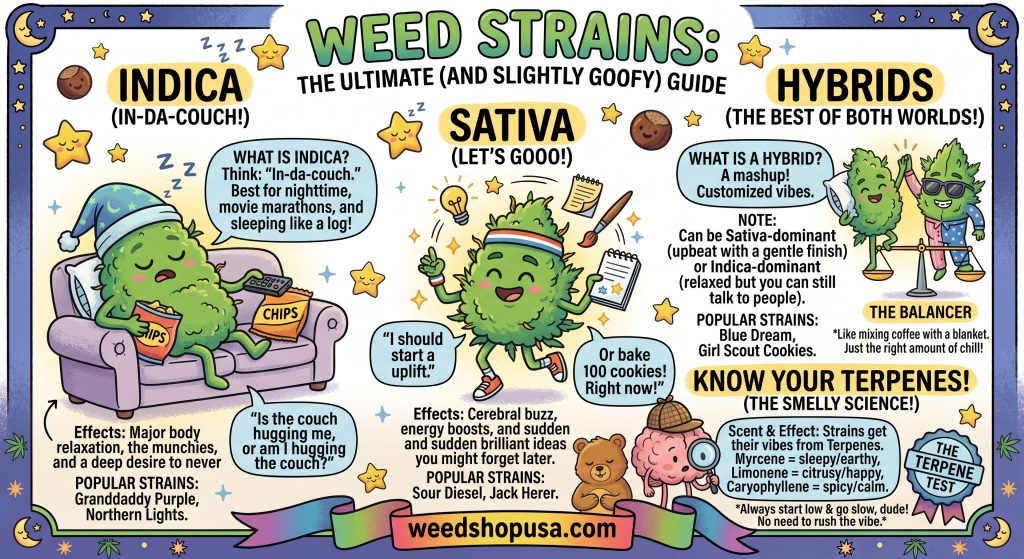
Indica, sativa, and hybrid are familiar retail categories. Consumers often associate them with different experiences, but those associations should not be treated as dependable clinical predictions.
| Retail category | How it is commonly presented | Important limitation |
|---|---|---|
| Indica | Frequently associated with relaxation or evening use | The label does not guarantee sedation |
| Sativa | Frequently associated with alertness or daytime use | The label does not guarantee stimulation |
| Hybrid | Presented as mixed ancestry or characteristics | It does not establish a precise balance of effects |
A study published in Nature Plants found that the sativa–indica labeling scale poorly captured overall genetic and chemical variation in the samples examined. Some chemical associations existed, but the labels did not provide a complete classification. Read the research on cannabis labeling and chemical variation. Nature Plants
The practical implication is that a category can provide context without replacing product-specific information.
Avoid assuming that every indica will make someone sleepy or every sativa will improve concentration. Individual response remains an important part of the picture.
Cannabis Strains, Marijuana Strains, and Ganja Strains
Cannabis strains, marijuana strains, and ganja strains usually refer to the same general subject in everyday searches: named cannabis varieties.
The words reflect different language traditions and contexts rather than separate systems for predicting effects.
Likewise, “different breeds of weed” is an informal way of asking about varieties and breeding history. “Cultivar” is another term readers may encounter when discussing cultivated plants, although commercial usage is not always consistent.
Clarifying vocabulary helps prevent confusion. A website may use several terms for the same material, but switching terminology does not change its measured composition.
When reading a description, ask whether it concerns:
- A named variety.
- A broad retail category.
- A chemical profile.
- A finished product.
A clear description should distinguish these rather than treating them as interchangeable.
Weed Names: What They Can and Cannot Tell You
Weed names may refer to reported ancestry, flavor associations, geographic references, appearance, or branding. A memorable name can make a variety easy to recognize, but recognition is not proof of consistency.
Consider familiar names such as Blue Dream, OG Kush, Sour Diesel, or Northern Lights as examples of naming conventions. Their appearance on packaging does not independently verify lineage or establish a fixed potency.
Before relying on a strain description, ask:
- Does the producer document the claimed identity?
- Are the images representative or batch-specific?
- Does the laboratory information match the available product?
- Are effect descriptions clearly identified as subjective?
- Does the seller distinguish evidence from marketing?
Statements such as “guaranteed happiness” or “always perfect for sleep” go beyond what a name can establish.
A useful article describes common associations without turning them into promises.
Why Chemical Profiles Matter More Than Names Alone
When comparing weed strains, cannabinoid measurements provide information that a name cannot.
THC and CBD are different compounds. Their measured concentrations help describe a product, although neither number alone predicts the full experience.
A label may also list terpenes, compounds associated with aroma. Those measurements can help characterize material, but an aroma profile should not be treated as proof that a product will treat a medical condition.
For example, “citrus aroma” describes a sensory characteristic. “Treats anxiety” is a medical claim requiring a different level of evidence.
Keep these distinctions clear:
| Information | What it helps describe | What it does not establish |
|---|---|---|
| Strain name | Claimed variety or commercial identity | Identical effects across products |
| THC percentage | Measured concentration | A guaranteed individual response |
| CBD percentage | Measured CBD concentration | Proven effectiveness for a condition |
| Terpene results | Part of the chemical and aroma profile | A guaranteed therapeutic benefit |
| Batch identifier | Connection to production documentation | Quality without supporting results |
This approach makes comparisons more informative without pretending that any single measurement answers every question.
Types of Prerolls: Understanding the Main Differences
The search “types of prerolls” concerns product construction rather than plant classification. A preroll is a prepared rolled product, and its contents may vary substantially.
Flower-Only Prerolls
These contain cannabis plant material without an advertised concentrate infusion. Check the ingredient information rather than assuming every rolled product contains flower alone.
Single-Strain Prerolls
These are presented as containing material from one named variety. The designation describes the claimed source material; it does not guarantee a consistent experience across batches.
Blended Prerolls
These may combine material associated with multiple varieties. A blend is a product formulation, so its description should explain the contents rather than relying only on a broad “hybrid” label.
Infused Prerolls
These include added cannabis material such as concentrates. An infusion can change the finished product’s cannabinoid composition, making it different from ordinary flower.
California’s labeling guidance specifically addresses infused prerolls, including options for reporting flower potency and added cannabinoid amounts. Consult the California Department of Cannabis Control’s manufactured-product labeling checklist. These are California requirements, not a nationwide standard. Department of Cannabis Control
Multipacks and Smaller Formats
These describe packaging or size rather than a separate variety. Compare the number of units, individual weight, total package weight, and actual contents.
Preroll Types and Weed Strains Are Different Classifications
A single named variety can appear in several formats. Conversely, one preroll can contain a blend of varieties or additional extracts.
For example:
- A flower-only product may carry a single variety name.
- A blended product may combine several named sources.
- An infused product may contain flower and a separate concentrate.
- A multipack may contain identical units or several different varieties.
This distinction matters because a prominent strain name may distract from other ingredients.
Read the product identity and complete composition before comparing strength. The name of the flower component does not necessarily describe everything in an infused preparation.
For more educational exploration, use weedshopusa.com while keeping variety names separate from format and ingredient information.
How to Compare Product Labels
A meaningful comparison starts with the documentation for the actual batch.
Look for:
- Product identity: What format and ingredients are described?
- Net quantity: Does the figure refer to one unit or the complete package?
- Cannabinoid content: Which compounds and units are reported?
- Batch information: Can the product be connected to its laboratory report?
- Testing details: Which relevant contaminants were assessed?
- Producer information: Is the responsible business clearly identified?
Percentages and milligrams are different measurements. A percentage describes proportion by weight, while milligrams describe an amount.
Similarly, a “lab tested” badge provides less information than a matching report with readable results. Documentation should support specific claims rather than serve as decoration.
Health Considerations When Researching Types of Weed
Different types of weed do not eliminate the risks associated with cannabis. THC-containing products can cause impairment, and stronger preparations are not automatically more suitable.
Cannabis can affect attention, memory, coordination, and other functions. Smoking also carries respiratory risks. The CDC cannabis health effects overview explains these concerns. CDC
Avoid driving while impaired. Keep products secured away from children and pets, and seek professional advice when considering cannabis for a health concern.
A strain name is not a medical diagnosis or treatment plan. Discuss medications, existing conditions, and previous adverse reactions with a qualified clinician rather than relying on a retail category.
U.S. Legal Context
A variety name does not establish legal status. Nor does a product being described as “natural,” “CBD-rich,” or “hemp-derived” settle every regulatory question.
Before relying on a seller’s description, check the requirements applicable to the exact product and location. Distinguish rules governing possession, medical access, adult-use sales, delivery, and cultivation.
California’s labeling guidance illustrates why product formats receive specific attention. A compliant label in one jurisdiction should not be treated as proof of permission everywhere.
Use official regulator information to verify requirements rather than assuming that a website’s checkout system makes the transaction lawful.
Frequently Asked Questions
1. What are weed strains?
They are named cannabis varieties commonly described by ancestry, appearance, aroma, or commercial identity. A name alone does not establish potency or predict an individual response.
2. Are indica and sativa reliable guides to effects?
They are familiar retail categories, but research shows that the labels do not fully capture genetic and chemical differences. Treat them as broad descriptors rather than guarantees. Nature Plants
3. Are cannabis strains and marijuana strains different?
In ordinary consumer discussions, the terms usually refer to the same general category of named varieties. Context and product-specific information matter more than the wording.
4. What are the main types of prerolls?
Common descriptions include flower-only, single-strain, blended, and infused products. Multipacks and smaller formats describe packaging or size rather than distinct plant varieties.
5. Does the highest THC percentage mean the best product?
No. A higher concentration does not establish quality, suitability, or a better experience. Consider the complete composition, batch documentation, and relevant health risks.
Where to Explore Further
Continue researching weed strains at weedshopusa.com. Compare names with documented composition, distinguish preroll formats, and check official guidance before relying on health or legal claims.
