Cannabis Education
What Is Hemp?
Oct
What Is Hemp? Uses, THC Content, and Differences From Marijuana
What is hemp? It is cannabis that meets a legally defined low-THC threshold. Farmers cultivate it for fiber, seeds, and compounds such as cannabidiol, commonly called CBD. Under the U.S. federal framework established by the 2018 Farm Bill, the definition includes cannabis containing no more than 0.3% delta-9 tetrahydrocannabinol by dry weight. www.fda.gov
That classification does not mean every product made from the crop is identical. A textile, cooking oil, CBD extract, and intoxicating gummy can have different ingredients, purposes, and legal requirements.
For American readers, understanding the plant means separating its agricultural uses from the effects of specific consumer products. This guide explains the terminology, answers common questions about THC, and shows how to assess labels without relying on marketing claims.
What Is Hemp Used For?
The crop supplies materials for several industries. Producers select varieties and cultivation methods according to whether they want stalks, seeds, or cannabinoid-rich flowers.
Common applications include:
- Textiles and rope: Manufacturers process stalk fibers into materials for clothing and other goods.
- Building materials: The woody inner stalk can become an ingredient in certain construction products.
- Food ingredients: Seeds provide oil, protein ingredients, and shelled kernels.
- Animal bedding: Processed stalk material can serve as an absorbent bedding material.
- Cannabinoid extracts: Suitable varieties provide compounds used in consumer formulations.
These applications should not be treated as interchangeable. Wearing a plant-fiber shirt has no relationship to consuming a cannabinoid extract. Likewise, a seed-based food does not have the same composition as a flower-derived preparation.
For further educational exploration, visit weedshopusa.com and consider which part of the crop a product uses before comparing it with another item.
Hemp vs Weed: Understanding the Terminology
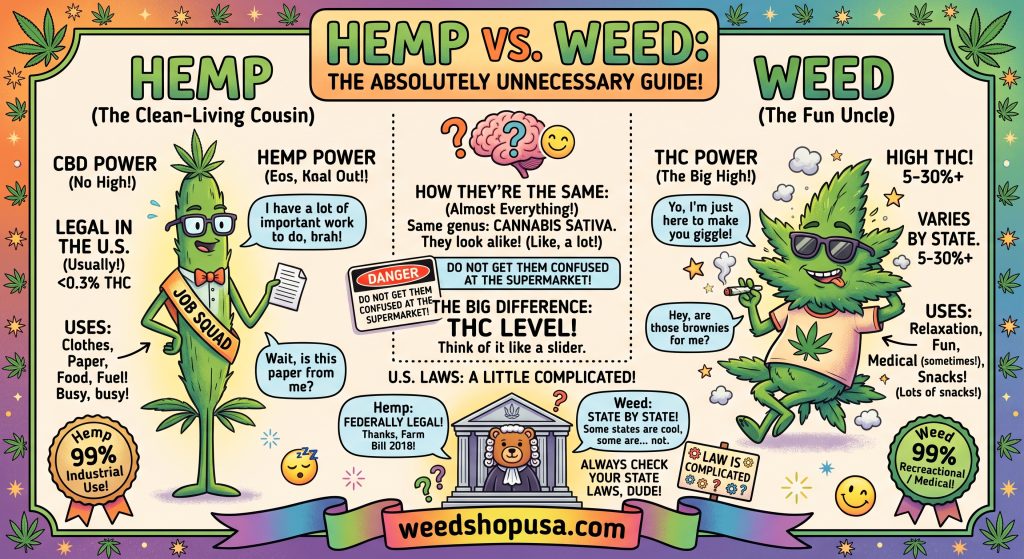
“Cannabis” is the broader plant term. “Weed” is an informal name that usually refers to marijuana associated with intoxicating THC.
The distinction involves legal classification and chemical composition. It does not mean the plants are entirely unrelated.
| Feature | Industrial crop meeting the federal definition | Marijuana |
|---|---|---|
| Plant relationship | Cannabis | Cannabis |
| Main distinction under the 2018 framework | Within the specified delta-9 THC limit | Outside that definition, subject to statutory exceptions |
| Common purposes | Fiber, seeds, and cannabinoid extraction | Products for adult use or state medical programs |
| Can appearance establish classification? | No | No |
| Does the name establish product safety? | No | No |
| Do finished products require separate legal checks? | Yes | Yes |
A photograph, smell, or product name cannot establish measured cannabinoid content. Documentation and appropriate testing provide more useful information than appearance.
Searches for “hemp vs marijuanas difference” generally ask about this same distinction. “Marijuana” is the usual spelling in modern consumer writing, although legal documents sometimes use “marihuana.”
The Difference Between Hemp and Marijuana
The clearest explanation starts with the legal threshold, then considers the specific plant or product.
Under the 2018 federal framework, qualifying material falls outside the Controlled Substances Act’s marijuana definition. However, separate requirements can still govern foods, extracts, cosmetics, and other finished goods. www.fda.gov
Chemical profiles also vary. Some varieties are cultivated for CBD production, while others are selected primarily for fiber or seeds. Marijuana products can contain CBD alongside THC, so the distinction is not simply “one contains CBD and the other contains THC.”
When comparing hemp vs marijuana, ask:
- What legal definition applies?
- Which cannabinoids were measured?
- Is the discussion about a crop or a finished product?
- What is the intended use?
- Which jurisdiction’s requirements matter?
These questions prevent a broad plant label from being mistaken for a complete description.
Does Hemp Have THC in It?
Yes. A low-THC classification does not mean zero THC.
The search term “hemp THC” can refer to the concentration measured in plant material or the amount present in a finished formulation. Those measurements are related, but they answer different questions.
A percentage describes the proportion of a substance by weight. Milligrams describe an actual amount.
For example, 0.3% of a hypothetical 5-gram product equals 15 milligrams:
5,000 milligrams × 0.003 = 15 milligrams
This calculation illustrates why a small percentage can represent a meaningful amount in a heavier item. It does not establish that the hypothetical product is lawful, safe, or suitable to consume.
When reading an edible label, distinguish the amount per serving from the amount in the complete package. Also check which cannabinoid the number describes.
Does Hemp Get You High?
The answer depends on the product’s ingredients.
People searching “does hemp gets you high” often expect a simple yes or no. However, seed foods, CBD preparations, and intoxicating cannabinoid products require different answers.
Seed Foods
Properly manufactured seed ingredients are not intended to produce a cannabis high. FDA explains that seeds do not naturally contain THC or CBD, although contact with other plant parts during harvesting and processing can introduce trace amounts. www.fda.gov
CBD Preparations
CBD itself does not produce the characteristic THC high. Nevertheless, a bottle or gummy advertised as containing CBD may include additional cannabinoids or other ingredients.
The CDC guide to CBD and product risks explains why consumers should distinguish CBD from THC-containing preparations. www.cdc.gov
Intoxicating Extracts
Some plant-derived consumer products contain intoxicating cannabinoids, including delta-8 THC. Their agricultural origin does not prevent impairment.
CDC warns that these preparations can be confused with nonintoxicating CBD products, particularly when labeling is unclear. archive.cdc.gov
Check the full ingredient list and measured contents. A statement about where an ingredient originated does not reliably predict its effects.
Is Hemp Marijuana, or a Different Plant?
Botanically, both belong within cannabis. Legally, qualifying low-THC material receives a different classification under the U.S. framework.
This distinction explains why apparently conflicting statements can both be accurate: the crop is cannabis, while qualifying material is excluded from the statutory marijuana category.
The question “is hemp the same as weed” usually concerns everyday terminology. People generally use “weed” to describe intoxicating marijuana, rather than seed foods or industrial fiber.
Confusion develops when an explanation switches between botanical, legal, and informal meanings without identifying the context. A useful article should make those distinctions clear.
What Is Hemp Seed Oil, and How Does It Differ From CBD Oil?
Seed oil comes from seeds. CBD oil contains cannabidiol, typically combined with a carrier oil.
These products can share similar packaging, but their names should not be treated as proof of equivalent contents. A CBD formulation might use seed oil as a carrier, while a plain culinary oil may contain no added cannabidiol.
Before drawing conclusions, check:
- The complete ingredient list.
- Whether cannabidiol is specifically identified.
- The measured amount of CBD, if present.
- Whether a laboratory report matches the finished product.
- What any milligram figure actually represents.
A prominent number may describe the total oil or extract weight rather than the amount of CBD.
FDA has evaluated specific seed-derived food ingredients. That evaluation does not establish approval for every cannabinoid preparation. Its cannabis regulatory questions and answers explain the distinction. www.fda.gov
U.S. Legal Requirements: Why Product Details Matter
A qualifying agricultural crop does not automatically make every derived consumer item lawful nationwide.
Requirements can differ according to product type, ingredients, intended use, labeling, and location. Rules for cultivation also do not answer every question about manufacturing, sale, possession, or delivery.
Federal requirements are changing. Minnesota’s Office of Cannabis Management currently reports that a revised definition is scheduled to take effect on December 11, 2026, unless further federal action occurs. Its guidance describes a total-THC standard and a 0.4-milligram total-THC limit per container for finished cannabinoid products covered by the change.
Read the official guidance on federal hemp changes before relying on older summaries. mn.gov
A checkout page accepting your address is not a legal determination. Similarly, broad statements about compliance with the Farm Bill may omit other applicable requirements.
How to Evaluate Labels and Laboratory Reports
Understanding what is hemp provides a starting point. Assessing a particular item requires more detail.
Identify the Product
Determine whether it is a seed food, textile, cosmetic, extract, or edible. Compare products serving similar purposes rather than grouping everything under one plant name.
Read the Amounts Carefully
Distinguish extract weight from measured cannabinoid content. Check serving information alongside the amount in the entire package.
Match the Batch
A certificate of analysis should identify the relevant product, batch, laboratory, and testing date. A report for another batch gives less direct information about the package in front of you.
Understand Testing Language
“Not detected” means a test did not detect a substance above its reporting threshold. It does not establish absolute absence.
A laboratory report also does not prove that a preparation treats a medical condition. Composition testing and clinical research answer different questions.
For additional educational exploration, use weedshopusa.com alongside independent evidence and government guidance.
Frequently Asked Questions
1. What is hemp in simple terms?
It is cannabis that meets the applicable low-THC legal definition. Farmers grow it for materials, seeds, and cannabinoid extraction. Finished products can have different contents and requirements.
2. Does hemp have THC in it?
It can. Low THC does not necessarily mean THC-free. Review the measured contents of the specific item rather than relying on its plant-based description.
3. Can a plant-derived gummy cause intoxication?
Yes, if it contains sufficient intoxicating cannabinoids. Agricultural origin alone does not determine whether a formulation can impair you. archive.cdc.gov
4. Is seed oil the same as CBD oil?
No. One comes from seeds, while the other contains cannabidiol. Read the ingredient list because similar packaging can conceal substantial differences.
5. Are all products in this category legal throughout the United States?
No blanket statement covers every formulation. Federal, state, and local requirements can depend on the ingredients, product type, and activity involved.
Where to Explore Further
Continue researching what is hemp at weedshopusa.com. Before evaluating any product, identify its purpose, measured ingredients, supporting documentation, and applicable legal requirements.
