
Cannabis Education
Weed Buds
Oct
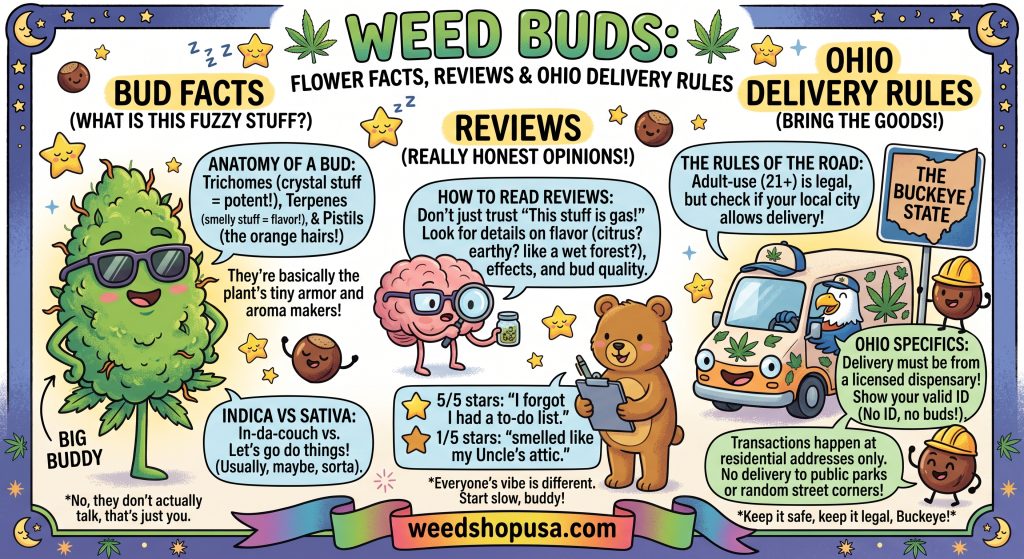
Weed Buds: Cannabis Flower, Seller Reviews, and Ohio Delivery Rules
Weed buds are the flower clusters commonly associated with cannabis. Retailers may describe them as flower, cannabis buds, or marijuana buds. These terms often refer to similar plant material, but a product’s name does not establish its cannabinoid content, safety, or legal status.
For U.S. readers, understanding flower also means evaluating the information surrounding it. Attractive photographs, customer ratings, and delivery advertisements can leave important questions unanswered. What does the label measure? Is the seller appropriately licensed? Does the advertised service comply with the rules where you live?
This educational guide explains the basics of cannabis flower, how to assess website reviews, and what readers researching delivery in Columbus or Cleveland should verify.
What Are Weed Buds?
In everyday cannabis terminology, a bud is a flower cluster. Commercial flower products generally contain harvested plant material that has undergone drying and other post-harvest handling.
The CDC explains that cannabis is also commonly called marijuana, weed, pot, or bud. However, “cannabis” can describe more than flowers, including other plant parts and derived products. Its overview of cannabis provides useful background. CDC
A flower product differs from a concentrate, edible, or tincture. Those preparations may involve additional processing and ingredients, making direct comparisons difficult.
When evaluating a description, first identify the actual product type. A page showing flowers might also advertise extracts or infused preparations. Similar branding does not make their composition equivalent.
For further educational exploration, visit weedshopusa.com and distinguish general cannabis terminology from claims about a particular product.
Cannabis Buds and Marijuana Buds: Are They Different?
Cannabis buds and marijuana buds often describe the same type of material in ordinary conversation. The distinction usually concerns terminology rather than a separate physical form.
“Cannabis” is a broader plant term. “Marijuana” often appears in legal and consumer discussions about cannabis products associated with THC. However, a casual name cannot replace the applicable legal definition.
Likewise, a search such as “bud weed plant” usually reflects interest in identifying the flowering portion of the plant. Identification should not become an assumption about potency.
A photograph cannot reliably establish:
- The amount of THC or CBD.
- Whether contamination is present.
- The accuracy of a strain name.
- Whether the pictured batch matches the available product.
- Compliance with the relevant legal requirements.
Use images to understand appearance, then consult documentation for measurable claims.
What Can Appearance Tell You About Weed Buds?
Color, shape, and visible surface features can help describe flower. They cannot independently prove quality or safety.
Some products appear green, purple, or a mixture of colors. Bud size and density also vary. These differences do not create a reliable ranking of strength or suitability.
Similarly, a strong aroma is not a laboratory result. Descriptions such as “premium,” “top shelf,” and “exotic” are marketing terms unless the seller explains an objective standard.
A useful product page should identify the item clearly and provide supporting information. If the photograph is presented as representative rather than batch-specific, that distinction should be apparent.
Avoid treating visual appeal as evidence that a product will produce a particular experience. Individual responses and chemical composition matter more than an attractive image.
Reading Flower Labels and Testing Information
Weed buds should be assessed through their documented contents rather than their name alone.
| Information | Why it matters | Question to ask |
|---|---|---|
| Product identity | Distinguishes flower from infused or processed preparations | What exactly is being described? |
| Cannabinoid results | Provides measured composition | Which compounds and units are reported? |
| Batch identifier | Connects documentation to the item | Does the report match this batch? |
| Testing date | Helps place the results in context | When was the sample tested? |
| Laboratory information | Identifies who performed the analysis | Is the laboratory appropriately authorized? |
| Contaminant results | Provides information beyond potency | What substances were tested? |
A certificate of analysis may help document composition, but it does not prove that a preparation treats a medical condition.
Also distinguish percentages from milligrams. A percentage describes a proportion, while milligrams describe an amount. Check the units and whether the result applies to the entire product, a serving, or a laboratory sample.
Weed Buds and Health Effects
THC-containing flower can cause impairment. Cannabis can affect attention, memory, coordination, and other functions. Smoking also introduces respiratory risks.
The CDC cannabis health effects guidance explains these concerns and provides information about cannabis use disorder and other potential harms. CDC
A label such as “natural” does not remove these risks. Nor does a customer’s positive experience predict how another person will respond.
Medical claims require particular care. Flower descriptions should not promise a cure for insomnia, anxiety, pain, or another condition without appropriate evidence and authorization.
Anyone considering cannabis for a health concern should discuss the issue with a qualified healthcare professional, including current medications and previous adverse reactions. Avoid driving or operating machinery while impaired.
“Is Weed Com Legit?” How to Assess the Question
The search “is weed com legit” asks several possible questions at once. A website can exist and process orders while still leaving questions about licensing, product accuracy, or legal delivery unresolved.
This article does not establish a verified endorsement or finding of fraud about that business. A meaningful assessment requires evidence tied to the exact operator, product, and transaction.
Separate the questions:
- Business identity: Is the legal operator clearly identified?
- Licensing: Does it hold any authorization required for its activities?
- Product information: Are ingredients and testing claims supported?
- Customer service: Are contact and dispute procedures clear?
- Legal availability: Is the specific product permitted in the destination jurisdiction?
A familiar domain name, secure connection, or polished design cannot answer all five.
The presence of a checkout page also does not establish that a sale is lawful. Verify substantive claims independently.
How to Read Weed Com Reviews Critically
Searches for “weed com reviews” may return customer comments, the seller’s own testimonials, and automated website ratings.
Each source has limits. A seller-hosted review may describe a real experience but remains published on a platform the seller controls. An automated trust score generally cannot confirm cannabinoid content or compliance with cannabis regulations.
When comparing reviews, look for:
- Clear dates and specific transaction details.
- Evidence of verified purchases where available.
- Repeated issues across independent accounts.
- Explanations of how complaints were resolved.
- Disclosure of referral payments or other incentives.
Distinguish fulfillment from product quality. Receiving a package does not establish that its contents match the label. Equally, one complaint does not independently prove that every transaction is fraudulent.
Use weedshopusa.com for further educational exploration, while keeping seller claims separate from independently verified evidence.
Weed Delivery: Ordering Online Is Not the Same as Delivery
Weed delivery can mean different things in search results. Some pages describe local dispensary services. Others advertise shipping, pickup reservations, or delivery of accessories.
An online ordering system does not necessarily authorize home delivery. A retailer may accept reservations online but require collection at its licensed premises.
Before interpreting an advertisement, identify:
- The exact product category.
- The business providing the service.
- The required license or authorization.
- Whether the service is pickup, local delivery, or shipping.
- The eligibility requirements for the customer.
This distinction is especially important when a nationwide website appears in a local search.
Weed Delivery Columbus Ohio: What Does Current Law Say?
Readers searching “weed delivery Columbus Ohio” or “weed delivery Columbus” should distinguish medical delivery provisions from adult-use sales.
Ohio Revised Code Section 3796.20, effective March 20, 2026, permits a licensed dispensary to provide medical marijuana delivery in accordance with adopted rules. That statutory language does not establish that every dispensary currently offers the service or that adult-use home delivery is generally authorized. Ohio Laws
Consult the official Ohio dispensary law and confirm the applicable operating rules before relying on an advertisement.
The practical questions are whether the advertised service is authorized, whether the customer qualifies, and whether the operator is licensed for the relevant activity.
Older articles may describe a different legal framework. Check their publication dates and the effective dates of the provisions they cite.
Weed Delivery Cleveland and Downtown Searches
The phrase “weed delivery Cleveland” does not establish a separate legal category. The applicable state framework still matters, along with any relevant local requirements and the operator’s authorization.
Similarly, “weed delivery downtown” is a location-based search rather than evidence that a delivery service is permitted.
For either search, ask the business to distinguish medical delivery from adult-use sales and online pickup ordering. Then verify its explanation against official requirements.
Do not infer availability from a map listing, search advertisement, or neighborhood name. A business may appear nearby while offering a different service or product category.
A Practical Checklist for Evaluating Weed Buds Information
Before trusting a flower description or delivery claim:
- Identify the actual product and its documented contents.
- Check whether laboratory information matches the batch.
- Separate appearance and marketing from measurable facts.
- Verify the business’s relevant authorization.
- Distinguish pickup, local delivery, and shipping.
- Check the current rules for your location.
- Treat reviews as supporting information rather than proof of legality.
These checks help readers make sense of conflicting search results without assuming that popularity establishes reliability.
Frequently Asked Questions
1. What are weed buds?
They are cannabis flower clusters commonly described as flower or marijuana buds. Their name alone does not establish potency, safety, or legal status.
2. Can you identify strong flower from a photograph?
Not reliably. Appearance cannot establish cannabinoid concentration or contamination. Relevant testing and batch documentation provide more useful evidence.
3. Is weed com legit?
A definitive answer requires verified information about the operator, relevant licensing, product claims, and transaction practices. This article does not provide a verified endorsement or finding of fraud.
4. Is cannabis delivery available in Columbus, Ohio?
Ohio law provides for medical delivery by licensed dispensaries in accordance with adopted rules. Confirm current implementation, eligibility, and operator authorization rather than assuming all advertised services qualify. Ohio Laws
5. Does online ordering mean home delivery is legal?
No. Online ordering may simply reserve an item for pickup. Check the exact service and the applicable legal requirements.
Where to Explore Further
Continue your educational research at weedshopusa.com. When reviewing weed buds, focus on documented composition, clear business information, and current official rules rather than relying on photographs or delivery promises.
